



A small marketing experiment is one limited try of one marketing change. Before you start, write down the decision it informs, a guess you could prove wrong, a budget cap, an end date and the results that mean keep, change or stop. Then run it once and follow your own rule.
That last part is where most small tests go wrong. People try something, glance at the numbers, and then argue about what the numbers mean. Without a rule written in advance, the loudest opinion wins, and the test teaches nothing.
This guide walks you through six steps you can finish this month, even with a small budget and modest website traffic. You will pick one idea worth testing, count the full effort before you commit, and set your keep, change and stop rules before you spend a dollar. At the end there is a worksheet you can copy and fill in today.
A small marketing experiment defined, and what it is not.
A small marketing experiment changes one thing, for one group of people, measured one way, for a fixed period. One new offer on one service page counts. A revised follow-up email to past customers counts. A single social post with a phone number on it counts too.
It is not a campaign launch. A campaign commits money and time to an idea you already believe in. An experiment is cheaper on purpose, because its job is to tell you whether that commitment makes sense.
It also does not prove cause on its own. Formal designed experiments follow a careful sequence. The e-Handbook of Statistical Methods from the US National Institute of Standards and Technology lists seven steps. They run from setting objectives to using the results, which may lead to further runs. That method assumes control and repeated runs that a small business test rarely has.
So treat a small test as evidence for a decision, not as proof. If you run one email and replies go up, the email may be the reason. The season, a competitor closing or a lucky week may also be the reason. You still learn something useful, as long as you stay honest about how sure you can be.
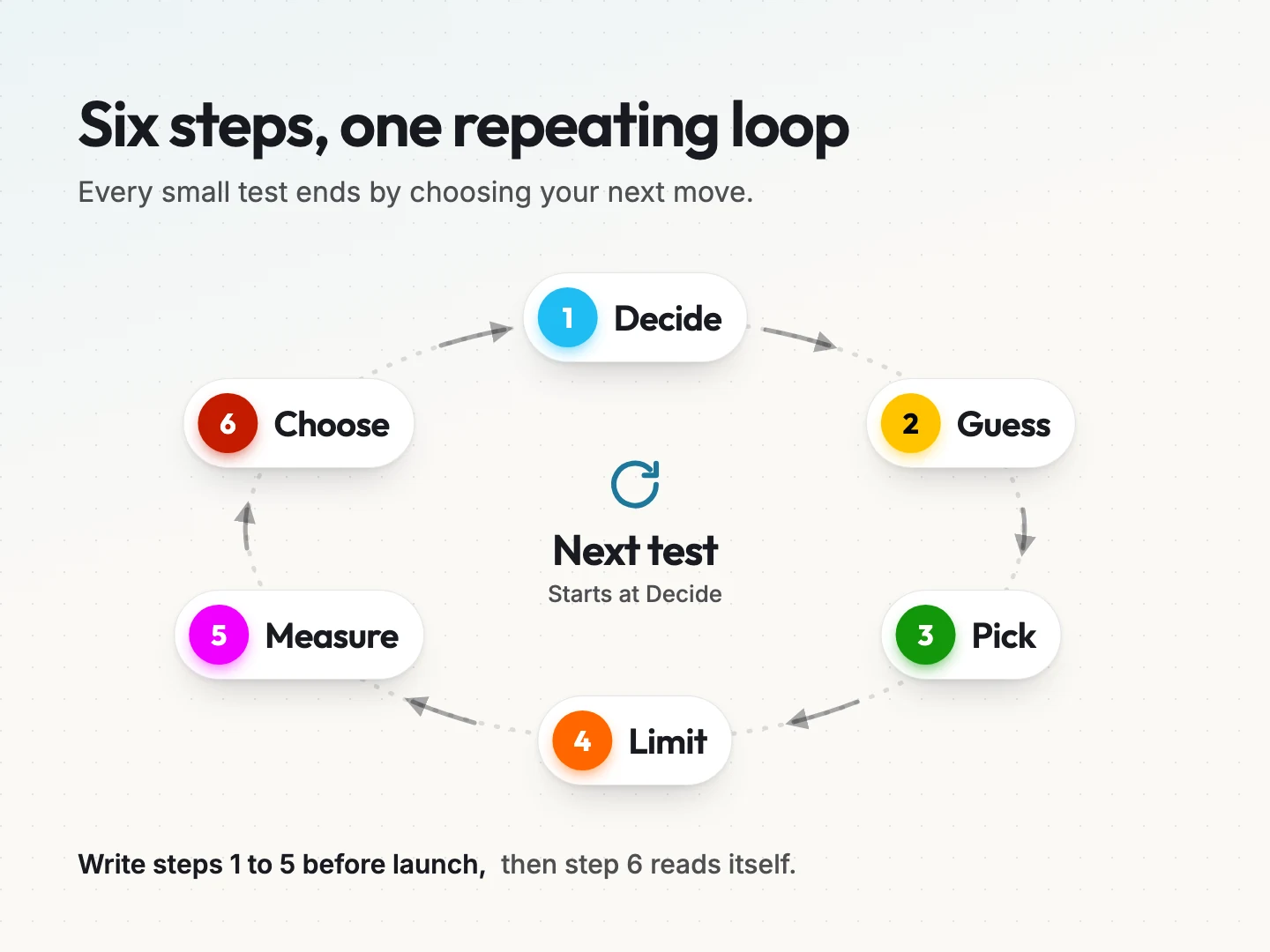
The six steps in the loop above are the sections that follow. Decide what the test should change. Write a guess. Pick the idea. Set the limits. Choose the measure. Then run it and choose your next move, which usually starts the next loop.
Use a controlled A/B test when you have the volume.
An A/B test shows two versions to two randomly split groups at the same time, then compares the results. Statistical significance is the check that tells you the gap between the two groups is unlikely to be chance.
You need that kind of test when the decision is expensive and you have enough volume to split. A store with thousands of weekly visitors can do it. A plumber with a few hundred visits a month usually cannot reach a reliable answer in any useful time.
If you do have the traffic, write the split-test rules before you start. If you want help drafting the test plan with an assistant, the A/B testing AI skill gives you a structured starting point. For everything smaller, the steps below work fine.
Step 1. Write down the decision the test should change.
Start with the decision, not the idea. Ask yourself what you will do differently depending on how the test turns out. If the answer is “nothing,” the test is a hobby, not an experiment.
Write the decision as a choice between two actions. Here is a hypothetical example for a house cleaning company. “Do we keep paying $200 a month for the directory listing, or move that money into email to past customers?” Both options are real, and the test helps you pick one.
A good decision sentence has three parts.
- Two clear options. Keep or drop, this channel or that one, this offer or the current one.
- A date. The decision gets made on a set day, not “when we have enough data.”
- One owner. One person makes the call and records it, even if the team discusses it first.
Naming the owner matters more than it sounds. In a small team, everyone assumes someone else is watching the numbers. When one name sits on the worksheet, the test gets read and the decision gets made.
If you are weighing a whole new channel, compare the options before choosing one to test. Then come back and test the one that survives.
Step 2. Write a guess you could prove wrong.
A hypothesis is a guess you could prove wrong. It says what you will change, for whom, what you expect to happen and by when. If no result could ever show the guess was wrong, it is a wish, not a hypothesis.
Use this plain template.
“If we change [one thing] for [one group of people], we expect [one measurable result] by [date].”
Here is a hypothetical example for an accounting practice. “If we add a free 15 minute call offer to the tax services page, we expect at least 4 call bookings from that page by the end of the month.”
Notice what makes that guess testable. It names one page, one change and one countable result. It sets a line that the result either clears or misses. And it gives a date, so nobody can keep the test running until the numbers look better.
Vague guesses sound like “better social media will help.” You cannot fail that guess, so you cannot learn from it. Tighten it until a stranger could read your result and say whether you were right.
Count your starting number first.
Your baseline is your starting number. It is what normally happens before you change anything. Without it, a result of “4 bookings” means nothing, because you do not know whether 4 is high or ordinary.
Pull last month’s count for the thing you want to change, even a rough one. Calls from the website, contact form entries, replies to your newsletter or bookings from one page all work. If your tracking is patchy, start by agreeing what counts, using this guide to choose business conversion goals.
If you have no baseline at all, run your measure for two weeks with nothing changed. It feels slow, but it is the cheapest part of the whole experiment, and it stops you from celebrating normal noise.
Step 3. Pick one idea with three checks and a quick score.
Most owners have more ideas than time. The fastest way to choose is two passes. First, three yes or no checks remove ideas that should not run at all. Then a quick score ranks what is left.
Three checks before any score.
Ask these three questions about each idea. Every answer must be yes.
- Is it true? Every claim in the offer, ad or email must be accurate. If you cannot back it up, it fails. The source-quality guide helps you test the wording.
- Can you deliver it? If the test works, can your team handle the extra calls, the discount or the faster reply you promised?
- Are you allowed? You need permission to contact the people on your list, and the channel’s rules must allow what you plan to send.
An idea that fails any check gets a hold. A hold is not a low score. It means the idea waits until the problem is fixed, however good it looks. A high score on an untrue offer is still an untrue offer.
Score effort and impact from 1 to 5.
For the ideas that pass, give each one two scores from 1 to 5. Effort is the total cost in money, hours and attention, including setup, writing, approvals and reading the results. Impact is how much the result would change your decision if the guess turned out right.
Count effort honestly. A “quick” landing page often needs copy, images, a form, a test submission and someone to answer the new enquiries. Write every task down before you score it. Hidden effort is the most common reason a small test runs late.
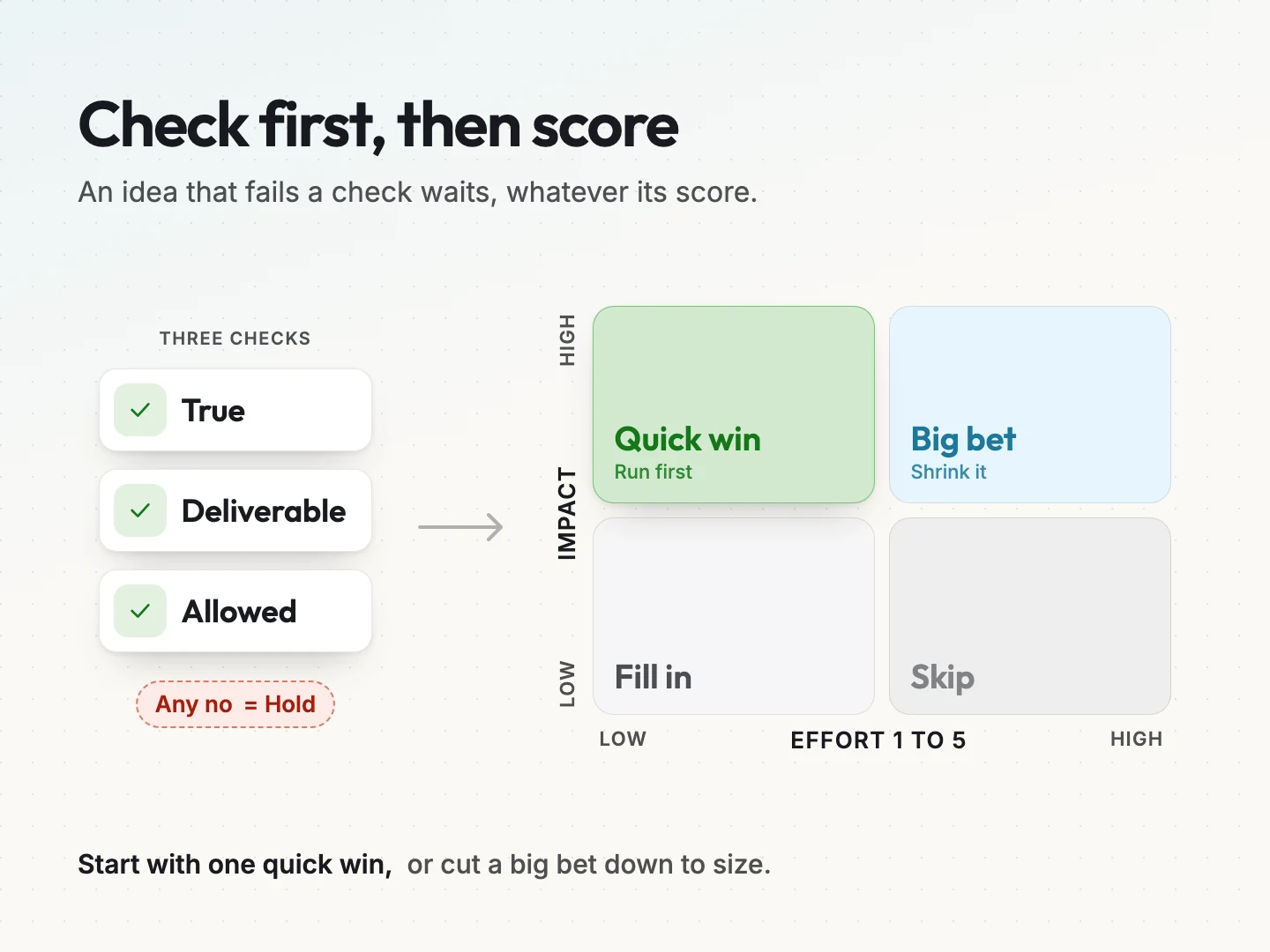
Then place each idea on a simple grid.
| Zone | Effort | Impact | What to do |
|---|---|---|---|
| Quick win | Low | High | Run it first. |
| Big bet | High | High | Plan it carefully, or shrink it into a smaller first test. |
| Fill in | Low | Low | Run it only if you have spare time. |
| Skip | High | Low | Drop it for now. |
Pick one quick win to start. If your list has no quick wins, take the best big bet and cut it down. Test one page instead of the whole site, or one email instead of a sequence. If you struggle to rank ideas, set an order before committing to a test.
Step 4. Set a budget cap, an end date and stop rules.
Limits come before the measure, because the end date decides how long you will count. Set all three before launch, while you are still calm and nothing has happened yet.
Budget cap. Spend only what you could lose without changing your business plan. That number differs for every business. The test is simple: if the money disappeared with nothing to show for it, would you need to cut something else? If yes, the cap is too high. Include paid tools, ad spend and any discount you give away.
End date. Pick a fixed end date that matches how often the action happens. If you get a few enquiries a week, four weeks gives you something to count. If you send one email, a week after the send is usually enough to read replies. Add one check in date halfway through, so problems surface early.
Stop rules. A stop rule ends the test early. Write two or three before launch. Here are three common ones.
- Customers complain about the offer or the message.
- You cannot keep a promise the test made, such as a reply time.
- The budget cap is reached before the end date.
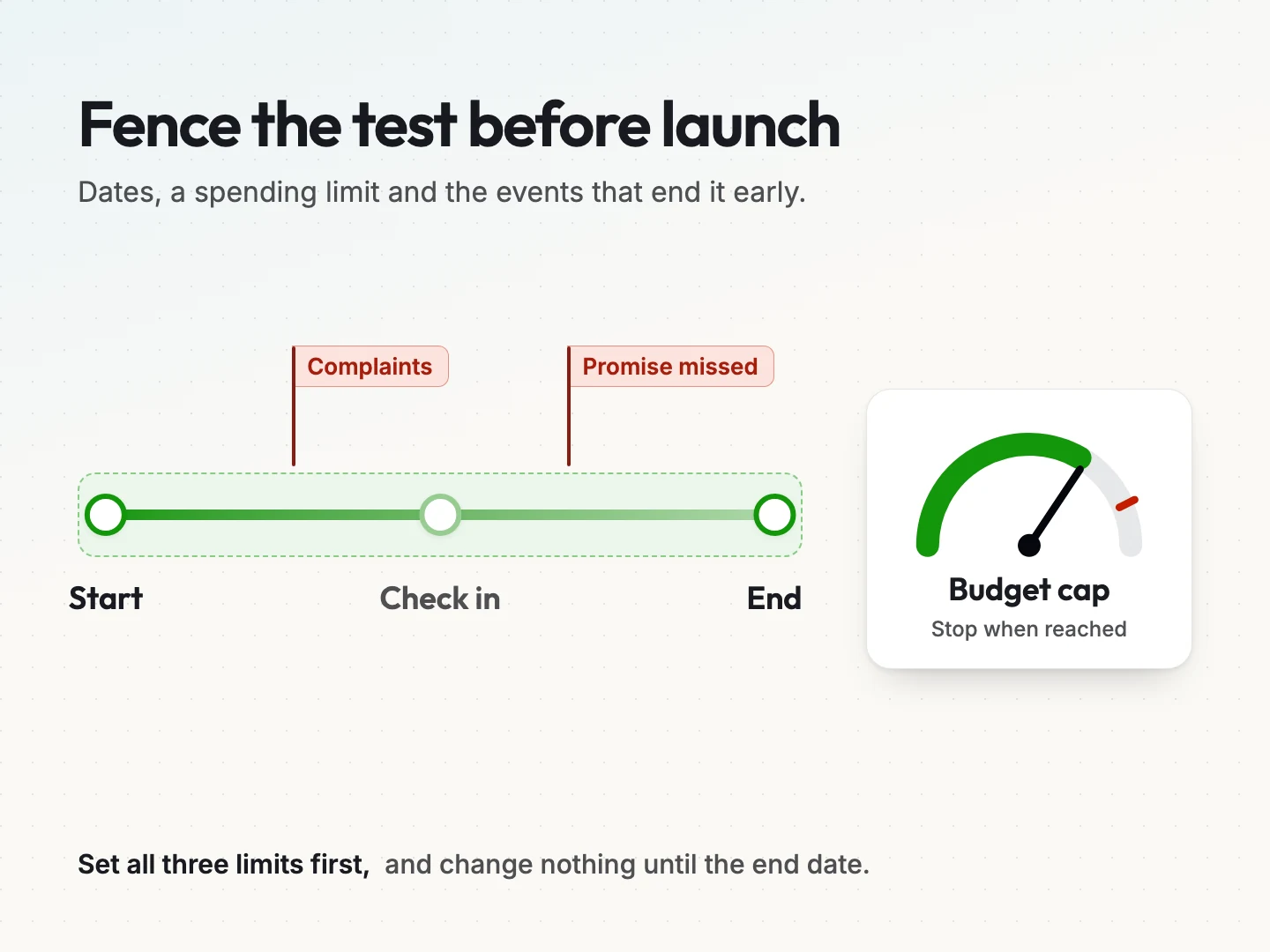
Stop rules protect your reputation as well as your money. A test that annoys your best customers costs more than any ad budget. When a stop rule triggers, end the test, record why and treat the record as a result.
One more limit is worth writing down: what you will not change during the test. Leave the price, the page and the offer alone until the end date. Every mid-test tweak makes the result harder to read.
Step 5. Choose one measure you can read with small numbers.
Pick one measure, and make it an action a person takes. Calls, form entries, booked appointments, email replies and repeat orders are all good. Likes, impressions and time on page are weaker, because they rarely change a decision on their own.
Small businesses usually work with small numbers, so read them carefully.
- Count, do not convert to percentages. “6 bookings against a usual 3” is honest. “A 100% lift” from the same numbers sounds like proof and is not.
- Compare with your own baseline. Industry averages describe other businesses with other customers. Your own last month is the fairer comparison.
- Watch for one big swing. If a single customer brought five friends, note it. One unusual event can make a small test look better than it is.
- Track the source. Tag the links in your test with a consistent UTM naming convention, so the visits from your test do not blur into everything else.
Add one question you will ask the people who respond. “What made you get in touch this week?” works well. The answers often explain a result your numbers cannot, and they cost nothing. If you want more depth, use a short set of questions from the customer persona worksheet with two or three of them.
Finally, write the line the result must clear before you start. Using the accounting example, “4 or more bookings from the page” is the line. Decide it now, because after the test you will be tempted to move it.
Step 6. Run it once, then keep, change or stop.
Launch the test on the start date and leave it alone. Check it once at the halfway point for stop rules, not to judge the result. On the end date, the owner reads the count against the line and makes the call.
Use the three outcomes you wrote in advance.
- Keep. The result cleared the line, and nothing in the stop rules triggered. Roll the change out more widely or make it permanent.
- Change. The result came close, or the replies point to a fixable problem. Change one thing and run the test once more.
- Stop. The result missed clearly, or a stop rule ended it. Drop the idea and move the budget to the next one on your list.
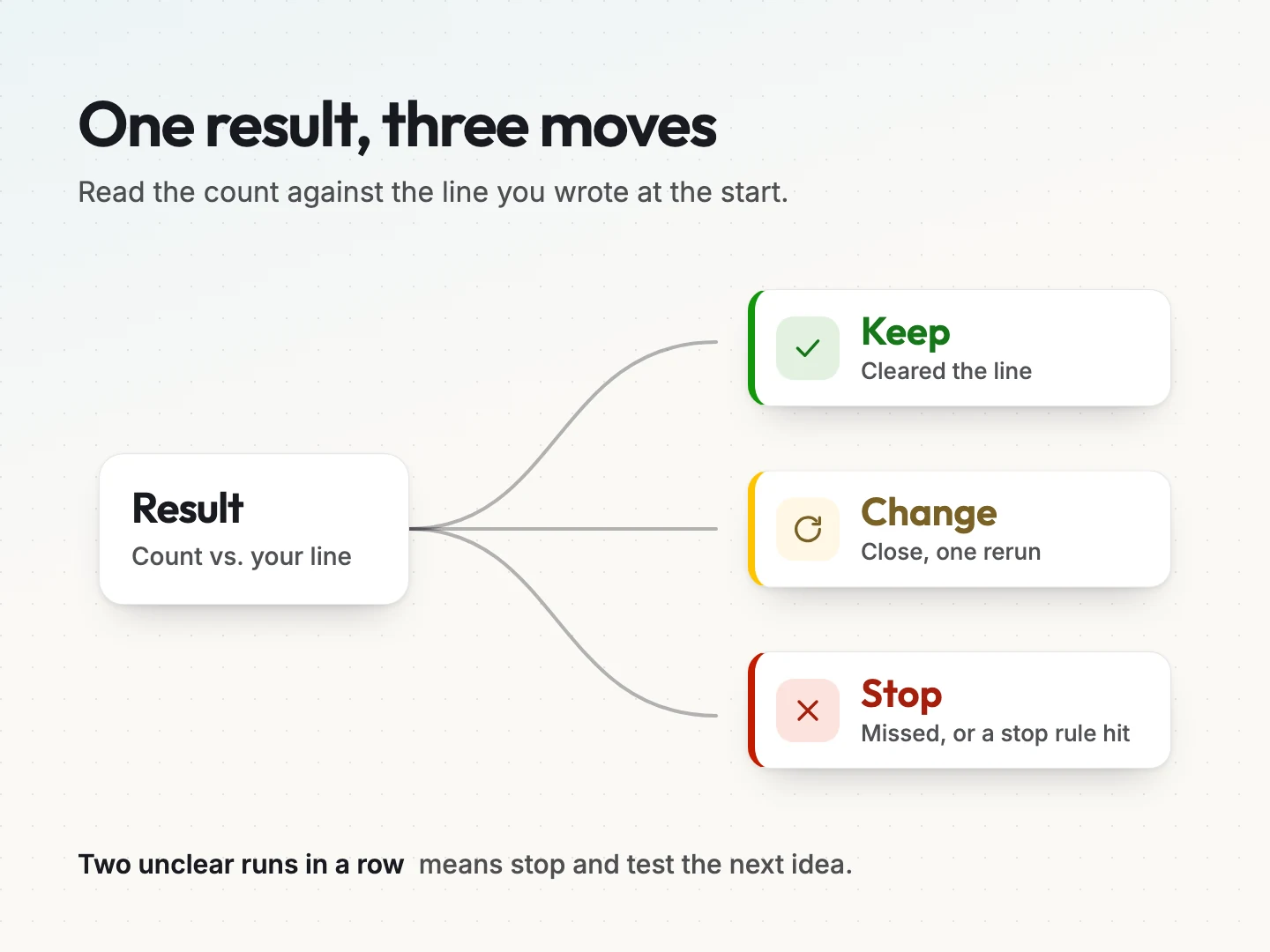
This pattern is not new. GorillaDesk’s free test and learn cards for local service businesses use a similar three-way choice, which they call pivot, patch or persevere. Whatever names you use, the point is the same. The rule exists before the result does.
Record the outcome on the worksheet, with the date and the reason. A short log of past tests becomes one of the most useful marketing documents a small business owns. It stops you repeating a test that already failed, and it shows new staff what has already worked.
Treat an unclear result as information.
An unclear result is information, not failure. It usually means one of three things. The change was too small to matter, the test ran too briefly to count, or something outside the test got in the way.
Allow one rerun with one change. Make the difference bigger, run it longer, or fix the problem the replies pointed to. If the second run is unclear as well, stop. Two unclear results tell you the idea is not strong enough to be worth more of your time right now.
A small marketing experiment worksheet you can copy.
Copy this worksheet into a document, a spreadsheet or a notebook. Fill in every line before launch, except the last three. Keep one page per experiment.
- Experiment name. A short name you will recognise later.
- Owner. The one person who reads the result and makes the call.
- Decision. The choice this test informs, written as option A or option B.
- Guess. If we change this one thing for these people, we expect this result by this date.
- Baseline. Last month’s count for the measure, and where it came from.
- The one change. Exactly what is different, and what stays the same.
- Checks. True: yes or no. Deliverable: yes or no. Allowed: yes or no. Any no means hold.
- Scores. Effort from 1 to 5. Impact from 1 to 5.
- Budget cap. The most you will spend, including tools and discounts.
- Dates. Start date, check in date and end date.
- Stop rules. Two or three events that end the test early.
- Measure and line. The one action you will count, and the number it must reach.
- Question for respondents. The one question you will ask people who reply.
- Keep rule. What result makes this permanent.
- Change rule. What result earns one rerun with one change.
- Stop rule for the idea. What result drops it.
- Result. The count on the end date.
- Call. Keep, change or stop, with the date.
- What we learned. One or two sentences for the next test.
A filled example to copy from.
Here is the worksheet filled in for a hypothetical dental practice. The numbers are made up to show the format, not taken from a real business.
| Field | Hypothetical entry |
|---|---|
| Decision | Keep the new patient offer on the website, or remove it. |
| Guess | If we add a free whitening consult to the new patient page, we expect 5 or more consult bookings by the end of the month. |
| Baseline | Last month the page brought 2 bookings, counted from the booking form. |
| Checks | True: yes. Deliverable: yes, two open slots a week. Allowed: yes. |
| Scores | Effort 2. Impact 4. |
| Budget cap | $300 in staff time and consult hours. |
| Dates | Start on the 1st, check in on the 15th, end on the 30th. |
| Stop rules | A complaint about the offer, or no free slots left. |
| Keep, change, stop | Keep at 5 or more. Change at 3 or 4. Stop at 2 or fewer. |
Five small marketing experiments a service business can try.
These are hypothetical ideas, not results. Each one is small enough to run in a month, and each changes one thing you can count.
- A clearer button on one service page. Replace “Submit” with what happens next, such as “Get my quote by Friday.” Count form entries from that page against last month. If your site has deeper problems, start with website design that increases sales or ask about conversion optimization.
- One email to past customers. Send a short, personal note offering a seasonal check in. Count replies and bookings within a week. Before you send it, use these tips to improve email open rates, so a weak subject line does not sink a good offer.
- A referral request script. Give your team one sentence to use at the end of every finished job for two weeks. Count referrals that mention it. Make sure the team can deliver the thank you you promise.
- A short answer video on one page. Record a one minute video answering your most common question and add it to the matching service page. Count calls or enquiries from that page.
- One offer post on your business profile. Publish one clear offer with an end date on your local listing. Count calls and direction requests during the offer window.
Mistakes that turn a small test into wasted money.
Most failed experiments do not fail because the idea was bad. They fail because the test could not answer anything. These are the patterns to avoid.
Changing several things at once. A new headline, a new price and a new photo in the same week leave you guessing which one mattered. Change one thing per test.
Moving the line after the result. If 3 bookings becomes “a good start” when you hoped for 5, you have stopped testing and started defending. The line you wrote first is the line.
Skipping the baseline. Without last month’s number, every result looks like a success or a failure depending on your mood.
Ignoring hidden effort. A test that cost little in ad spend but took twenty hours of your time was not cheap. Count the hours on the worksheet.
Running it forever. An experiment with no end date drifts into “how we do things now,” without anyone deciding it should.
If you run several tests a quarter, keep each experiment’s dates and owner in one shared record.
Final thoughts on running small marketing experiments.
A small marketing experiment is not about being scientific for its own sake. It is about spending a little money to make a bigger decision with less guessing. The decision comes first, the rule comes before the result, and the owner makes the call on the date written down.
Start with one worksheet this week. Pick the idea you keep talking about but never try, run it through the three checks and give it a cap, an end date and a line to clear. One finished test teaches you more than ten ideas on a list.
If you want a second opinion on which idea to test first, our marketing strategy and planning team can help you build the plan. Bring your filled worksheet and talk to a specialist about the one marketing idea you want to test next.
Was this article helpful?


