



Customer segmentation for a small business means sorting your customers into a few groups that you treat differently on purpose. A useful segment has three parts: a written admission rule, evidence that shows who meets it and one action you take differently for that group. If nothing changes for a group, it is a label, not a segment.
Most small businesses already have informal groups. You might talk about “the big accounts”, “the one-off jobs” or “the people who always call”. The trouble is that those names rarely change anything. Everyone still gets the same welcome email, the same onboarding call and the same follow-up schedule.
This guide shows you how to turn those loose groups into segments your whole team can use. You will write rules a colleague can apply without asking you, keep unknown customers visible instead of guessing, settle customers who fit two groups and give each segment one clear action. At the end there is a segment admission table you can copy into a spreadsheet today.
Customer segmentation for a small business, in plain terms.
A customer segment is a group of current or past customers who share a trait that matters to how you serve them. Customer segmentation is the work of defining those groups and deciding who belongs in each one. Segmentation criteria are the traits you sort by, such as what someone bought, what they need or where they are.
For a large company, segmentation often means statistical models and dedicated software. For a small business, it is usually a short list of groups in a spreadsheet or a CRM, plus a few rules that say who goes where. That is enough. What matters is that the groups change your decisions.
Segments, personas and email lists are different tools.
These three ideas get mixed up, so it helps to separate them early.
- A persona is a description of a typical customer, written to help you understand how they think. It is a portrait, not a list of real people. If you want to build one, the customer persona worksheet walks you through it.
- A segment is a group of real customers who meet a rule. You can count them, find them and act on them.
- An email list or tag is a delivery tool. It decides who receives a message. Our guide to email segmentation covers that job in detail.
This article works one level above all three. It is about deciding which groups exist across the whole business, so that service, onboarding, offers and messages can all follow from the same definitions.
Customer segmentation is not market sizing.
Segmentation sorts the customers you have or can reach directly. Market sizing estimates how many potential buyers exist in total. If you are still deciding whether a market is big enough to pursue, use TAM, SAM and SOM to estimate its size, then come back here once you have customers to sort.
The three-part test every segment has to pass.
Before a group earns a place on your list, check it against three questions. If it fails any of them, it is not ready to use.
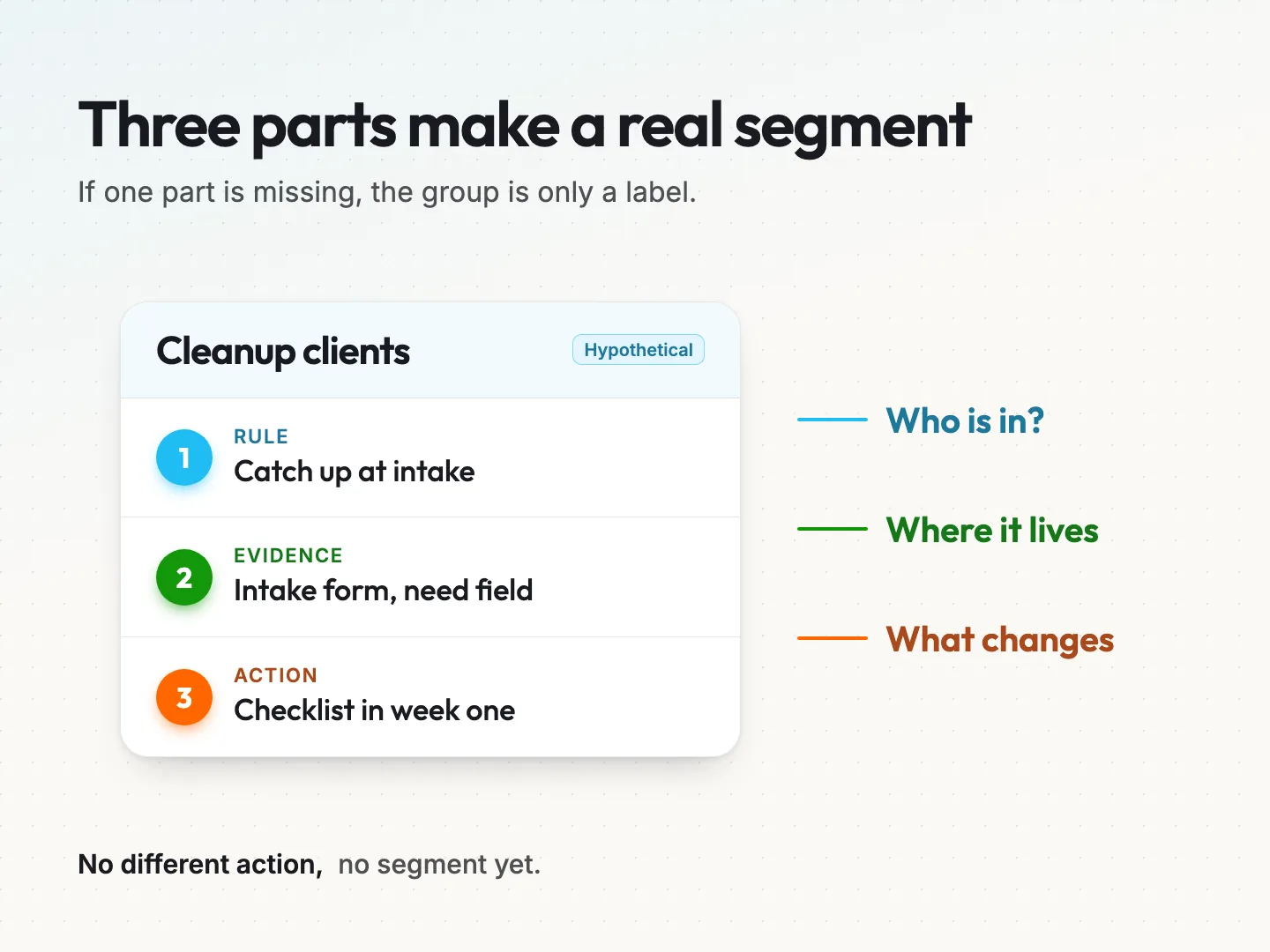
Part 1: an admission rule.
An admission rule is a sentence that decides whether one specific customer is in or out. It should be clear enough that two people on your team would place the same customer in the same group. “Customers who care about speed” is not a rule. “Customers who chose rush delivery on two or more orders” is a rule.
Part 2: evidence you can point to.
Every rule needs a source of truth. That might be an order history, an answer on an intake form, a note from a sales call or a field in your CRM. If you cannot say where the evidence lives, nobody can apply the rule consistently. Write the source next to the rule.
Part 3: one different action.
This is the part most segmentation guides skip. Ask yourself one question: what will we do differently for this group? The answer should be specific. A different onboarding step, a different follow-up timing, a different offer or a different person who answers their calls.
If the honest answer is “nothing yet”, park the segment. It might become useful later. For now it only adds noise to your records.
Segmentation criteria that change your next move.
There are many ways to sort customers. Most guides list the same families of criteria, and that list is a useful starting point. The real question for a small team is which criteria change what you do next, and which ones you can check without guessing.
| Criteria family | What it sorts by | Example for a small business | Usually changes |
|---|---|---|---|
| Needs-based | The problem the customer hired you to solve | Cleanup job versus ongoing monthly service | Onboarding, service scope, messages |
| Behavioral | What the customer has done | Bought once versus reorders regularly | Follow-up timing, offers |
| Value-based | How much and how often they buy | Large annual contract versus small occasional orders | Who owns the account, service level |
| Geographic | Where they are | Inside your service area versus outside it | Delivery, scheduling, local messages |
| Demographic or firmographic | Who they are, or what kind of company | Sole trader versus a team of twenty | Language and examples, sometimes pricing |
| Psychographic | Values, interests and attitudes | Prefers hands-off service versus wants detail | Tone and level of detail |
Needs-based and behavioral criteria tend to change your next action most directly, because they describe what the customer wants or does. They are also often easy to check, because the evidence sits in your orders and intake answers. Value-based criteria are easy to check in your billing too, and they mostly decide who owns the account.
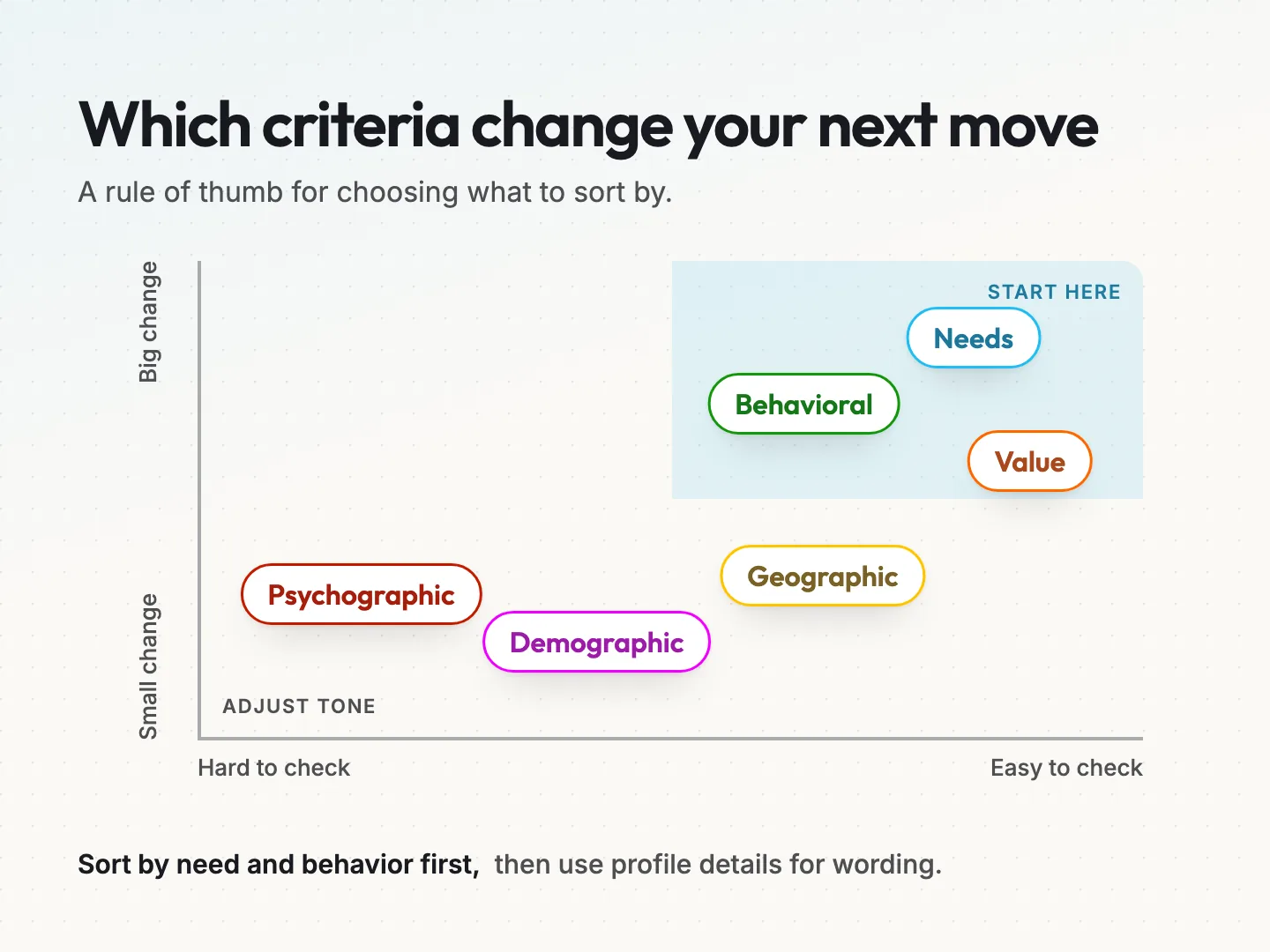
Demographic and psychographic details still have a job. They help you choose words, examples and channels. They are weaker as admission rules, because they are often missing or self-reported. Two customers with the same profile can also need different things.
If you use public data to understand a local population, the U.S. Small Business Administration’s market research guide lists federal sources such as the Census Bureau and the Bureau of Labor Statistics. That data describes markets, not your individual customers.
For a longer catalogue of criteria and example variables, HubSpot’s customer segmentation guide is a good reference. Treat any list as a menu. You only need the few criteria that change your work.
Segment customers by need before you segment by profile.
If you are starting from nothing, begin with need. Ask what job each customer hired you to do. Customers with the same job usually need the same onboarding, the same first deliverable and the same kind of follow-up, even when their profiles look nothing alike.
Here is a hypothetical example. A small bookkeeping practice has three types of clients.
- Owners who are months behind and need a one-time cleanup of their books.
- Owners who want a monthly close and a short report each month.
- Owners who only come in at tax time.
Those three needs call for three different first conversations. The cleanup clients need a document checklist and a clear end date. The monthly clients need a calendar and a reporting format. The tax-time clients need a reminder schedule. Company size or industry would not have told the practice any of that.
Places to find need evidence.
You probably have more need evidence than you think. Look in these places first.
- Intake forms and booking questions, especially any “what do you need help with” field.
- The first email or call notes, where customers describe their problem in their own words.
- The product or service they chose, and any add-ons.
- Support requests and the reasons people get in touch after buying.
If your intake does not ask about need, add one question. Keep it concrete, such as “Which of these best describes what you need?” with three or four options and an “other” field. To improve those questions, ask about the customer’s problem without suggesting the answer.
Write an admission rule a colleague can apply.
A good admission rule names what you observe, where you observe it and the threshold that counts. It avoids words that need judgment, such as “serious”, “engaged” or “high potential”. If a new team member could apply it on their first day, it is clear enough.
| Weak rule | Why it fails | Stronger rule |
|---|---|---|
| Customers who are loyal | Loyal is a judgment, not an observation | Customers with an order in each of the last three quarters, from order history |
| Big clients | Big could mean revenue, staff or effort | Clients on an annual contract above your chosen value, from billing |
| People who need help setting up | Everyone might need some help | Customers who answered “first time using a service like this” on the intake form |
| Local customers | Local is vague at the edges | Customers whose service address falls inside your listed service area |
Five checks for every rule.
Run each draft rule through these checks before you use it.
- Observable. It describes something recorded, not something you feel about the customer.
- Sourced. It names the field, form or report where the evidence lives.
- Dated. It says which time window counts, such as “in the last 12 months”.
- Repeatable. Two people would sort the same customer the same way.
- Fair. It does not rely on sensitive personal traits you have no business reason to use.
The fifth check matters. Do not build segments on guesses about age, health, religion or other personal characteristics. Sort by what customers did and asked for. It is more useful and far less risky.
Keep unknown membership visible instead of guessing.
Here is where most segmentation quietly goes wrong. When the evidence is missing, people guess. They assume a customer is in the “needs setup help” group because the company looks small. Or they leave the field blank, and blank gets treated as “no”.
Both mistakes hide a gap. A blank intake answer does not prove the customer is experienced. A large company does not prove a complex need. When you guess, you send the wrong onboarding with full confidence.
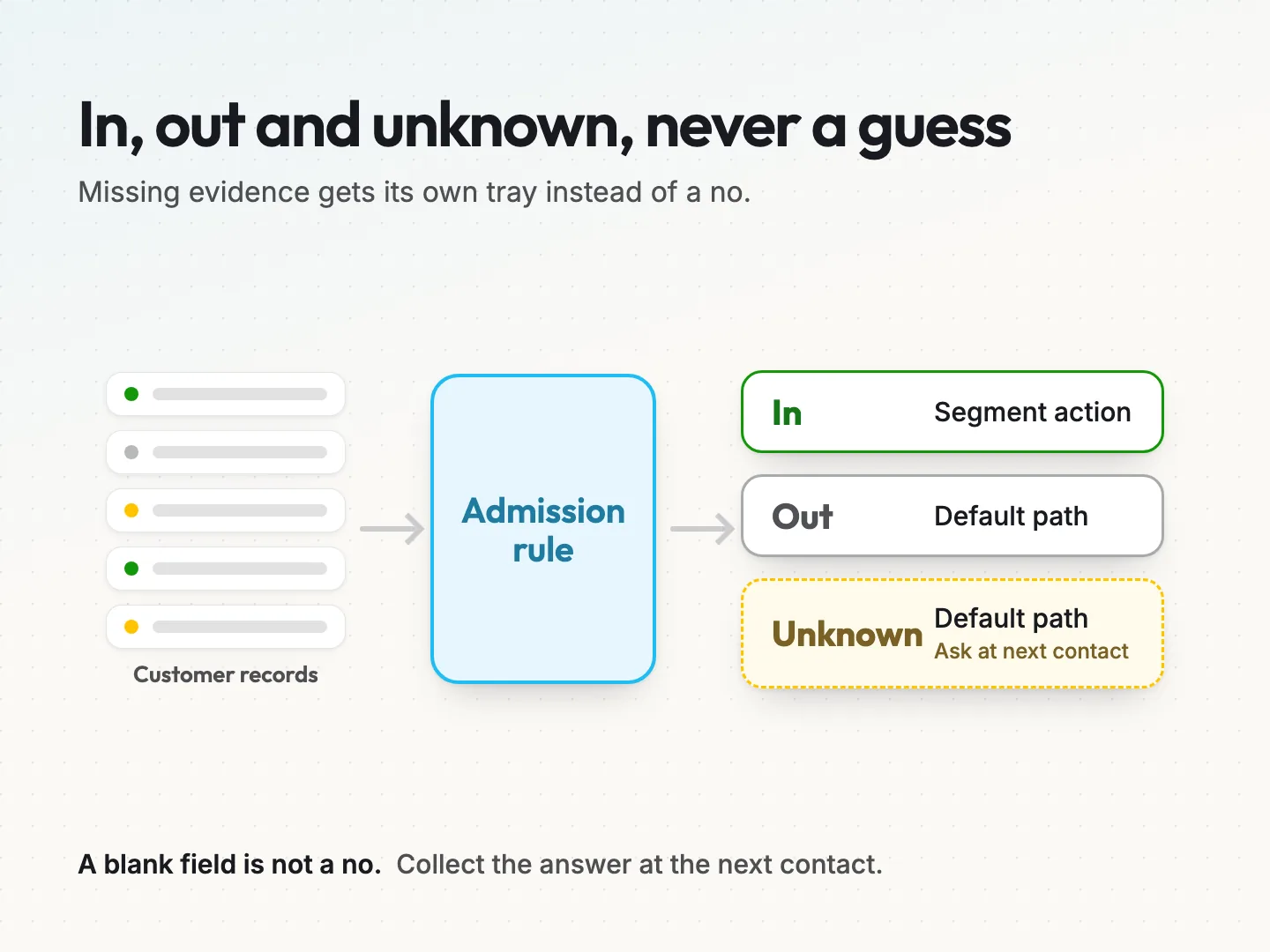
Use three states, not two.
Give every segment three possible states for each customer.
- In. The evidence meets the rule.
- Out. The evidence shows the rule is not met.
- Unknown. The evidence is missing, old or unclear.
Unknown customers stay on your default path. They get the same treatment everyone got before you started segmenting, which is safe. They also get a small task attached: collect the missing evidence at the next natural contact.
Resolve unknowns at the next contact.
You rarely need a special survey. Add the missing question to a moment that already happens. A booking confirmation can ask one need question. An onboarding call can include it in the first five minutes. A renewal email can ask whether their situation has changed.
Track how many customers sit in unknown for each segment. A large unknown pile is useful information. It tells you the rule depends on evidence you do not collect, so either change the rule or start collecting that evidence.
Customers who fit more than one segment.
Overlap is normal. A customer can be a monthly client and a high-value account at the same time. The problem is not the overlap itself. The problem is when both segments trigger different actions, and the customer gets two welcome sequences or two people calling them about the same thing.
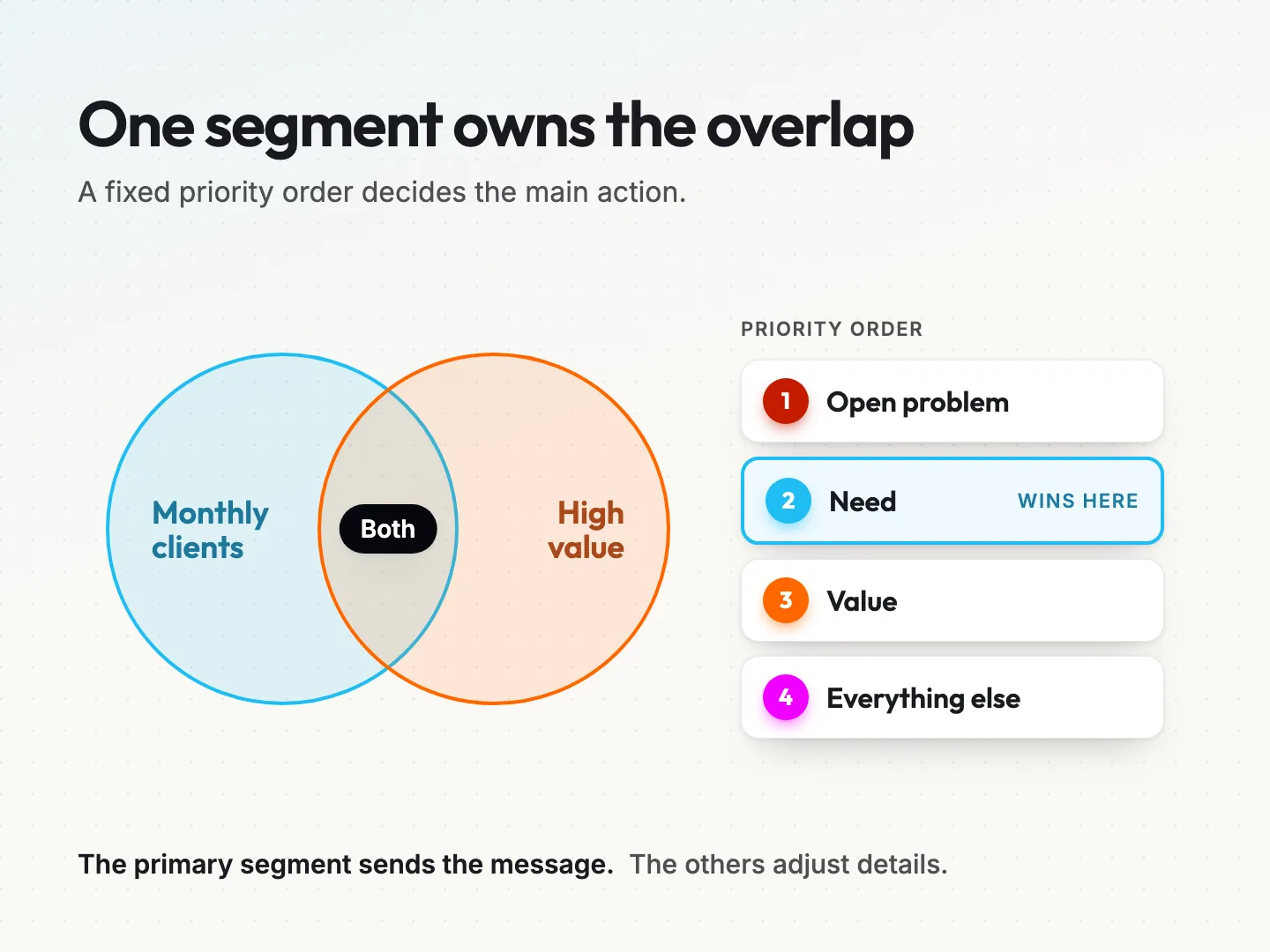
Set a priority order once.
Decide in advance which segment wins when two apply. Write the order down and keep it short. A simple order that works for many service businesses looks like this.
- Open problem. Anyone with an unresolved complaint or issue is handled as that first.
- Need. The job they hired you for decides onboarding and service.
- Value. Account size decides who owns the relationship.
- Everything else. Location, profile and preferences adjust tone and channel.
The winning segment becomes the customer’s primary segment. It owns the main action, such as the onboarding path. The other segments can still adjust details, like the account owner or the tone of the emails, as long as they do not send a competing message.
Check overlaps before each new action.
Each time you add an action to a segment, ask who else might receive something at the same moment. If two segments send emails on the same trigger, merge them or let the primary segment send alone. A quick check in your CRM or spreadsheet before launch saves an awkward double message.
Give each segment one different action.
Segments earn their place through action. Start with one action per segment, not five. One clear difference is easier to run, easier to measure and easier for your team to remember.
Look across the whole customer experience, not only marketing. Here are the places where one different action usually helps most.
- Personalized onboarding. Change the first step. A cleanup client gets a document checklist. A monthly client gets a calendar invite for the first close. Map the first useful step for each customer group.
- Service. Change who answers or how fast. High-value accounts might get a named contact instead of a shared inbox.
- Follow-up timing. Change when you check in. Repeat buyers might get a reorder reminder, while one-time buyers get a review request.
- Messages. Change the examples and the offer. Each segment sees the problem it has.
- Offers. Change what you suggest next. A tax-time client might be offered a quarterly check, not a monthly package.
If you are working out how these actions connect from first contact to repeat purchase, that is a funnel question. Our funnel strategy service maps each stage so segments get the right next step at the right time.
A hypothetical online store example.
Imagine a small online store selling refillable cleaning products. It has two need segments. Refill buyers ordered the same product at least twice. Gift buyers chose gift wrapping or entered a different delivery name.
The one different action is simple. Refill buyers get a reorder reminder timed to their usual gap between orders. Gift buyers get a note before the holidays about gift sets, and no refill reminders at all. Customers who bought once without gift wrapping stay unknown until a second order shows their pattern.
A segment admission table you can copy.
This table brings every piece together. Copy the columns into a spreadsheet, one row per segment. Fill in a row only when you can complete every column. A blank column is a sign the segment is not ready.
| Segment name | Admission rule | Evidence source | Unknown when | Priority | One different action | Owner | Review date |
|---|
The table filled in for a hypothetical bookkeeping practice.
Here is the same table completed for the hypothetical bookkeeping practice from earlier.
| Segment name | Admission rule | Evidence source | Unknown when | Priority | One different action | Owner | Review date |
|---|---|---|---|---|---|---|---|
| Cleanup clients | Chose “catch up on past months” at intake | Intake form, need field | Need field blank or “other” | 2 | Send document checklist and agree an end date in week one | Lead bookkeeper | Every quarter |
| Monthly clients | Signed a monthly service agreement | Billing system | Agreement not yet signed | 2 | Book the first monthly close date during onboarding | Account manager | Every quarter |
| Tax-time clients | Only work in the last 12 months was tax preparation | Job history | Client is new this year | 2 | Send a reminder schedule ahead of filing season | Office manager | Every year |
| Open issue | Has an unresolved complaint in the CRM | CRM ticket status | Ticket status unclear | 1 | Owner calls before any other message is sent | Practice owner | Every month |
Notice that “Open issue” sits at priority 1. It overrides every other action until the problem is closed. The three need segments share priority 2, because a client normally has one main need. If someone qualifies for two, the account manager picks one and writes a note.
Use the table in six steps.
- List your informal groups. Write down every customer group your team already talks about.
- Run the three-part test. Cross out any group with no clear rule, no evidence or no different action.
- Fill one row at a time. Start with the segment that would change the most if handled well.
- Sort a sample. Take 20 customers and place them in, out or unknown. If people disagree, tighten the rule.
- Launch one action. Turn on the different action for one segment only, then watch it for a full cycle.
- Add the next segment. Move on once the first one runs without anyone thinking about it.
Check whether each segment is earning its place.
A segment is a promise to treat a group differently. Keep checking that the promise is kept and that it helps. Put the review date from your table in the calendar and use these questions.
- Is the action happening? Pull the list of customers in the segment and check whether each one got the different action.
- Is the unknown pile shrinking? If it grows, your evidence collection is not working.
- Did something improve? Compare the segment with how the same kind of customer did before. Use a measure tied to the action, such as onboarding completion, reorder rate, response time or renewal.
- Do people still agree on the rule? If your team keeps arguing about who belongs, rewrite the rule.
Be patient with results. A change in onboarding might show up within weeks. A change in renewals might take a full year. Small segments also move around a lot, so a few customers can swing the numbers. Look for a steady pattern over more than one review before you decide.
Retire segments that change nothing.
If a segment has not changed any action for two review cycles, retire it. Keep the data if it might help later, but remove its actions and its place in your priority order. Fewer, working segments beat a long list nobody follows.
Re-sort customers when their situation changes.
Customers move between segments. A cleanup client might become a monthly client. A one-time buyer might start reordering. Check segment membership at the moments where change is likely, such as a renewal, a new order or a support request. Update the record, then let the new primary segment take over.
Final thoughts on customer segmentation.
Customer segmentation does not need software, a data team or a long list of personas. It needs a few groups your team can apply the same way, and a clear reason to treat each group differently. Rules, evidence and one action are what turn a name into a segment.
Start this week with one row. Pick the customer group that causes the most confusion today, write its admission rule, name its evidence source and choose one different action. Mark everyone else unknown and collect the missing answer at the next contact. That single row will teach you more than a full model you never use.
Want help mapping segments to your onboarding, follow-up and offers, or connecting them to your CRM? Talk to a specialist about a segmentation plan your team can run.
Was this article helpful?


