Integrated marketing for small business owners means every channel tells the same story and sends people to the same next step. It takes three things: one message brief, one job for each channel, and tools that pass every inquiry to a customer record and a person who follows up.
Most small businesses already run several channels. There is a website, an email list, a social account or two, maybe some search ads. Each one gets attention when someone has time. The trouble starts in the gaps between them, where an ad promises one thing, the page says another and the inquiry lands in an inbox nobody owns.
This guide shows you how to close those gaps with a small team and the tools you already pay for. You will write a message brief, give each channel a clear job, connect the handoffs, decide what to automate and measure the whole path without perfect data.
What integrated marketing means for a small business.
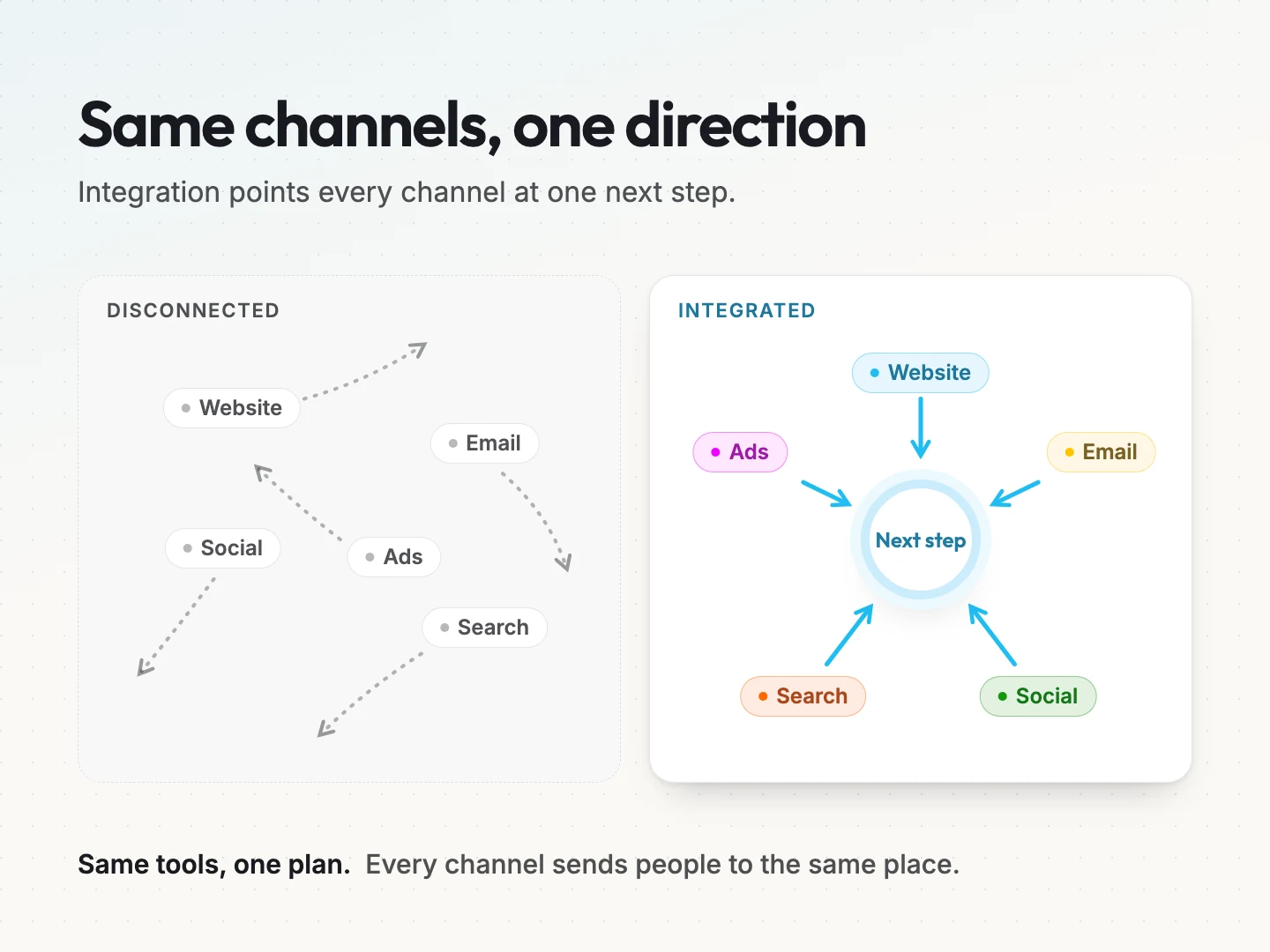
Integrated marketing is a plan that makes your channels work as one. Your website, email, social media, search and ads share the same message, point to the same offer and hand people to the same next step. You will also see it called integrated marketing communications, or IMC, which is the older textbook name for the same idea.
For a small business, there is a second half that most guides skip. The channels sit on top of systems: a contact form, a CRM, an email list and a phone. A CRM, short for customer relationship management software, keeps every contact, message and sale with one person in a single record.
If those systems do not pass information to each other, your marketing is not integrated, however consistent the wording looks. A matching ad and landing page still fail if the form sends the inquiry to a shared inbox and nobody replies for three days.
So the plan comes first, and the tools follow it. You do not need new software to start. You need to decide what each channel says, where it sends people and what happens after they act. Then you connect only the handoffs that plan needs.
Integrated, multichannel and omnichannel marketing compared.
These three terms get mixed up, and the difference matters when you plan. Multichannel marketing means you are present on several channels. Integrated marketing means those channels follow one plan. Omnichannel marketing describes the same integration from the customer’s side, where the experience feels continuous wherever they meet you.
| Term | What it means | The question it answers |
|---|---|---|
| Multichannel | You show up on several channels | Where are we present? |
| Integrated | Every channel follows one plan and one message | Do our channels work together? |
| Omnichannel | The customer moves between channels without starting over | Does it feel like one business to the customer? |
A small business can be multichannel without being integrated. That is the most common starting point, and it is fixable.
Signs your marketing is not integrated yet.
You can spot the problem from the inside without any data. Look for these signs.
- An ad or social post promises one offer, and the page it links to talks about something else.
- Each channel has its own tone, so customers meet a different business on email than on social.
- Website forms go to a shared inbox, and nobody is named as the person who replies.
- Nobody can say which channel a new customer came from.
- The person answering the phone does not know which offer is running this month.
- Email subscribers and past customers live in separate lists that never meet.
If two or more of these sound familiar, the fix is not more content. It is a shared plan and a few connected handoffs.
Write one message brief that every channel can use.
A message brief is a single page that says who you are talking to, what you offer them and what you want them to do next. Everyone who writes for a channel uses it. So does the person who answers inquiries, because the reply is part of the message too.
Keep it short enough to read in two minutes. A brief that runs to five pages will not be opened when someone writes a social caption at the end of a long day. Fill in these seven lines.
- Audience. Who this is for, in one sentence.
- Problem. What they are trying to fix, in their own words.
- Offer. What you are offering right now, and what it includes.
- Proof. Why they should believe you, using only facts you can back up.
- Next step. The one action you want people to take.
- Not a fit. Who should not take the offer, so replies stay honest.
- Reply owner. The person who answers inquiries about this offer.
The last two lines are the ones most teams leave out. “Not a fit” keeps your channels from overpromising. “Reply owner” makes sure the message continues after someone acts, instead of stopping at the form.
A hypothetical message brief.
Here is a hypothetical example for an invented home cleaning company running a spring offer.
- Audience: Busy households who want the house reset after winter.
- Problem: They have no time for a deep clean and do not know who to trust at home.
- Offer: A spring deep clean, booked through a short quote form.
- Proof: Insured staff, a written checklist for every visit and real customer reviews.
- Next step: Request a quote.
- Not a fit: Move out cleans and commercial spaces this season.
- Reply owner: The office manager, within one business day.
Every channel now has the same promise and the same next step. The ad, the email and the page will look different, but none of them will contradict each other. If you want help shaping the offer itself, a marketing strategy and planning session is a good place to start.
Give each channel one job in the customer journey.
The customer journey is the set of steps a person takes from first hearing about you to buying and coming back. It is rarely a straight line. People see a post, forget about it, search later, read an email and only then call.
Integrated does not mean pasting the same post on every channel. It means each channel carries one part of that journey and hands the person to the next part. The promise stays the same. The format and the job change.
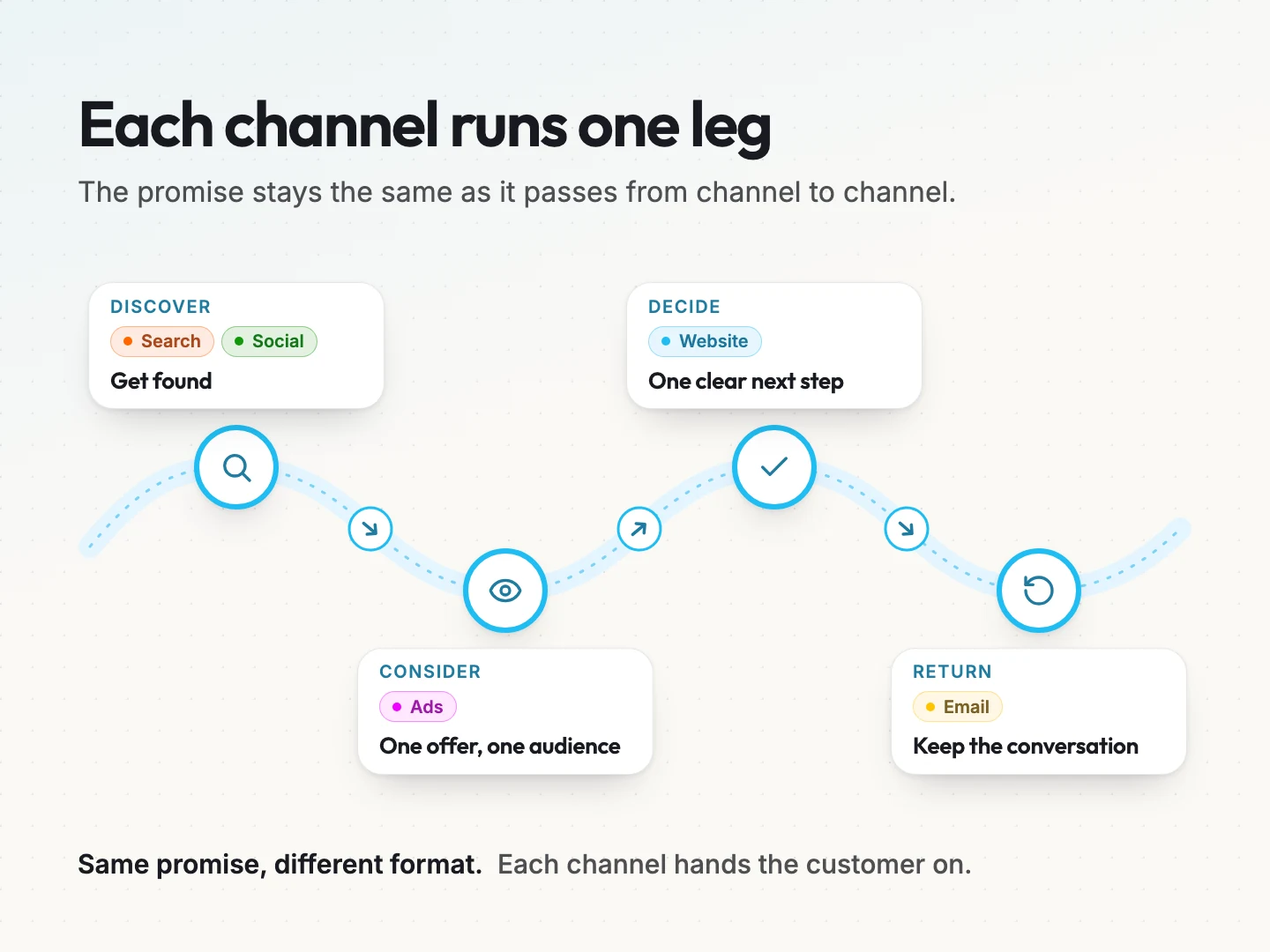
Here is a simple way to split the work for a service business. Adjust it to the channels you run.
| Channel | Main job | Journey stage | What it hands off to |
|---|---|---|---|
| Search | Answer the question people are already asking | Discover | A page that answers it fully |
| Social | Show your point of view and real work | Discover | Your profile, then the website |
| Ads | Put one offer in front of one audience | Consider | One landing page for that offer |
| Website | Turn interest into one clear next step | Decide | The form, the phone or a booking |
| Continue the conversation after the first contact | Return | A reply, a booking or a repeat visit |
Notice that the website sits in the middle. Almost every channel sends people there, so the page for your current offer has to match the brief exactly. If the page is weak, every other channel pays for it.
Same promise, different format.
Take the hypothetical cleaning offer again. A social post might show a before and after photo of one kitchen. The search article might answer how often a house needs a deep clean. The ad might name the spring offer and link to its landing page, the one page built for that offer. The email to past customers might offer them first pick of spring dates.
Four formats, one promise and one next step. That is what integration looks like from the outside.
Two or three channels done together.
You do not need every channel to do this well. A small team usually gets more from two or three channels that pass people along than from five that run on their own. Start with the channels your customers already use and add one only when the first ones run without effort.
Connect your website, CRM and email to one customer record.
This is the part most integrated marketing advice leaves out. Once a person acts, the channels have done their job. What happens next depends on whether your tools pass that person along with the right details.
The goal is one customer record per person. Every form fill, call, email reply and purchase adds to that record. Anyone on your team who opens it can see where the person came from, what they asked for and what was promised.
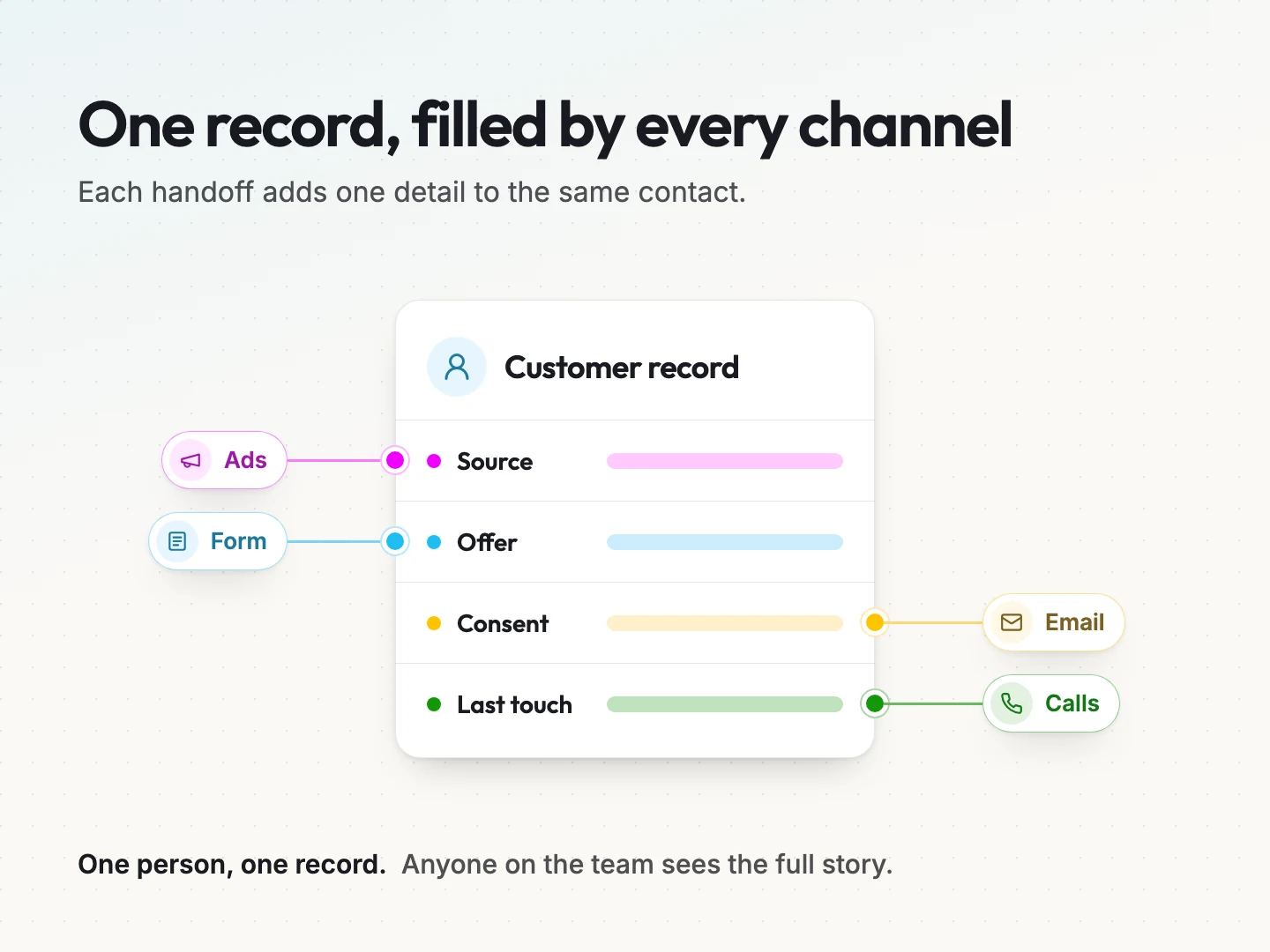
What each handoff should pass on.
At every handoff, four details need to travel with the person.
- Source. Where they came from, such as a search, an ad, an email or a referral.
- Offer. What they responded to, so the reply talks about the right thing.
- Consent. Whether they agreed to receive marketing email, and when.
- Last touch. The most recent contact, so nobody sends a promotion to someone with an open complaint.
In practice, that means three connections. The website form creates or updates the CRM record. The CRM adds the person to the right email list or segment. Replies and calls get logged back to the same record.
You can build these connections with the built-in integrations most form, CRM and email tools offer. When the tools do not talk to each other on their own, a CRM integration can connect them so the record stays complete.
If you are still choosing where that record lives, our comparison of the best CRM for customer retention looks at five tools on follow-up and shared history. Once the record is in place, email segmentation shows you how to split your list by how people joined and what they did.
Keep consent separate from service messages.
Consent means a person has given you permission to send them marketing email. It is different from the messages you send because they asked for something, such as a quote confirmation or an appointment reminder.
Keep the two apart in your records. Store when and how each person agreed to marketing email. Do not add everyone who requests a quote to your newsletter by default. Ask on the form, record the answer and respect it.
This protects your sender reputation, the trust inbox providers give your emails, and keeps you closer to the email rules where you do business. It also keeps your promotional list full of people who want to hear from you, which makes every send more useful. If you want help running the sends themselves, our email marketing service covers the writing and the schedule.
Automate the handoffs, and keep a person on the replies.
Automation is how a small team keeps these handoffs running without remembering every step. It should move information and start tasks. It should not replace the person who builds trust with a new customer.
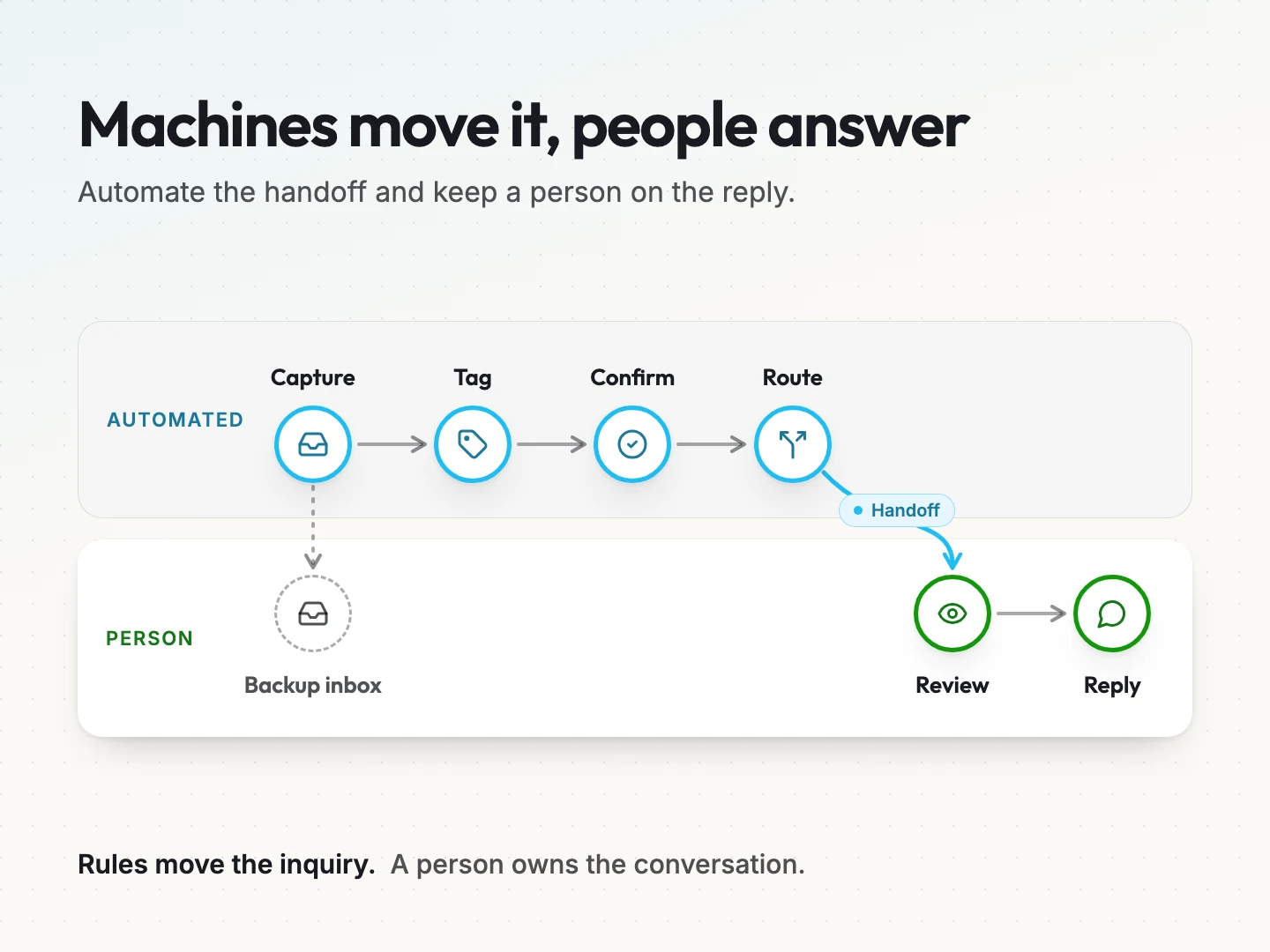
What to automate.
These jobs are repetitive and rule based, so they suit automation well.
- Capture. Create or update the CRM record when a form is submitted.
- Tagging. Add the source and offer to the record from the form and the link it came from.
- Confirmation. Send an instant reply that says the inquiry arrived and when a person will answer.
- Routing. Assign the inquiry to the reply owner named in your brief.
- Reminders. Create a task if nobody has replied by the time you promised.
- Triage. Let AI sort inquiries by topic or urgency, or draft a first reply for a person to check.
This is the kind of work CRM automation and AI lead management automation are built for. The rules stay simple, and the person stays in charge of the conversation.
What a person should review.
Some moments need judgment, tone and accountability. Keep these with a person.
- Replies to qualified leads, because the first real answer sets the relationship.
- Complaints, refunds and anything that sounds upset.
- Pricing questions and anything outside the standard offer.
- Inquiries the automation could not sort or tagged as unclear.
AI can draft a reply from the customer’s record. A person should read it before it goes out, at least until you trust the pattern.
Plan a manual fallback.
Integrations fail. A password changes, a field gets renamed or an app updates its connection. When that happens, inquiries can disappear without anyone noticing.
Plan for it now. Send a copy of every form submission to one monitored inbox as a backup. Check once a week that new inquiries appear in the CRM. Write down who fixes a broken connection, and what the team does by hand until it is fixed.
How to measure integrated marketing without perfect attribution.
Attribution is the practice of giving credit for a sale to the channels that led to it. For a small business it will never be perfect. People call instead of filling in the form. They hear about you from a friend. They see an ad on one device and buy on another.
That does not mean you cannot measure. It means you measure the whole path, use more than one signal and look for patterns instead of exact answers.
Pick one shared outcome.
Choose one result that every channel works toward, such as quote requests or booked calls. When each channel reports its own success, you get likes from social, opens from email and clicks from ads, and nobody can compare them. One shared outcome keeps everyone pointed at the same next step.
Tag your links with campaign parameters.
Campaign URL parameters, often called UTM tags, are labels added to the end of a link. They tell your analytics tool which campaign, source and medium sent each visit. Google’s help page on URL builders and custom campaign URLs says to always use utm_source, utm_medium and utm_campaign.
The same page explains that these values are case sensitive, so “Email” and “email” show up as two different rows. Pick a naming scheme, write it in your brief and use lowercase every time. Here is a simple pattern.
- utm_source: where the link sits, such as newsletter, facebook or google.
- utm_medium: the type of channel, such as email, social or cpc (cost per click, meaning paid ads).
- utm_campaign: the offer, such as spring-deep-clean.
Tag every link you control in emails, posts, ads and partner mentions. In Google Analytics, the visits then appear with those labels in the Traffic acquisition report, which shows where visits came from.
Ask every new customer.
Tags cannot see phone calls, word of mouth or a flyer on a fridge. Add a “How did you hear about us?” question to your form and ask it on the phone. Log the answer in the customer record.
The two signals check each other. If analytics says email sent few visits but customers keep naming your newsletter, both facts are useful.
A hypothetical monthly review.
Here is a hypothetical month for the invented cleaning company, in round numbers. The spring offer page received 400 tagged visits from email, 300 from social and 200 from ads. It produced 40 quote requests, and 25 of those people answered the “how did you hear” question.
Email sent the most visits. Yet when asked, many people named a friend first, and the email only reminded them to book. Ads sent the fewest visits, but a larger share of those visitors asked for a quote. Social sent 300 visits and few requests. A quick check shows the post linked to the home page instead of the offer page, so that link is next month’s fix.
Notice what the review does not do. It does not crown one winner. It looks at the path, finds the weakest handoff and fixes it next month.
Hold this review once a month. Look at visits by source, quote requests, how fast replies went out and the answers to your “how did you hear” question.
A 30-day integrated marketing plan for one offer.
You can set this up for one offer in about a month with one or two people. Pick an offer that already sells, so you are testing the system and not the product.
Week 1: baseline and brief.
- Write down your current numbers for the offer: monthly inquiries, where they come from and how fast you reply.
- Write the message brief, including “not a fit” and the reply owner.
- Read every channel’s current content for this offer and note where it disagrees with the brief.
Week 2: channel jobs and tags.
- Give each channel its job from the table above, using only the channels you run now.
- Update the offer page so it matches the brief and has one clear next step.
- Build your campaign tags and add them to every link that points to the page.
Week 3: connect and automate.
- Connect the form to the CRM, and the CRM to the right email list.
- Make sure source, offer, consent and last touch arrive in the record.
- Turn on the confirmation, routing and reminder automations, and set up the backup inbox.
- Send a test inquiry through every channel and follow it all the way to the reply.
Week 4: review and fix the weakest handoff.
- Compare the month with your week 1 baseline.
- Find the handoff where people stall, such as a slow reply, a confusing page or a missing tag.
- Fix that one handoff before you add any new channel or campaign.
After the first month, repeat week 4 every month. Integration needs upkeep. Tools change, offers change and people leave, so keep checking that each channel still hands people to the next one.
Final thoughts on integrated marketing.
For a small business, integrated marketing mostly means connecting what you already do. Write one brief. Give each channel one job. Make sure every inquiry reaches one record and one person who replies.
Then measure the path, not the channels on their own, and fix one weak handoff at a time. A small team with three connected channels can feel more organized to a customer than a bigger team running every channel on its own.
If you want help mapping one offer from first touch to follow-up and connecting the tools behind it, talk to a specialist about your marketing setup.
Was this article helpful?